 Skip to content

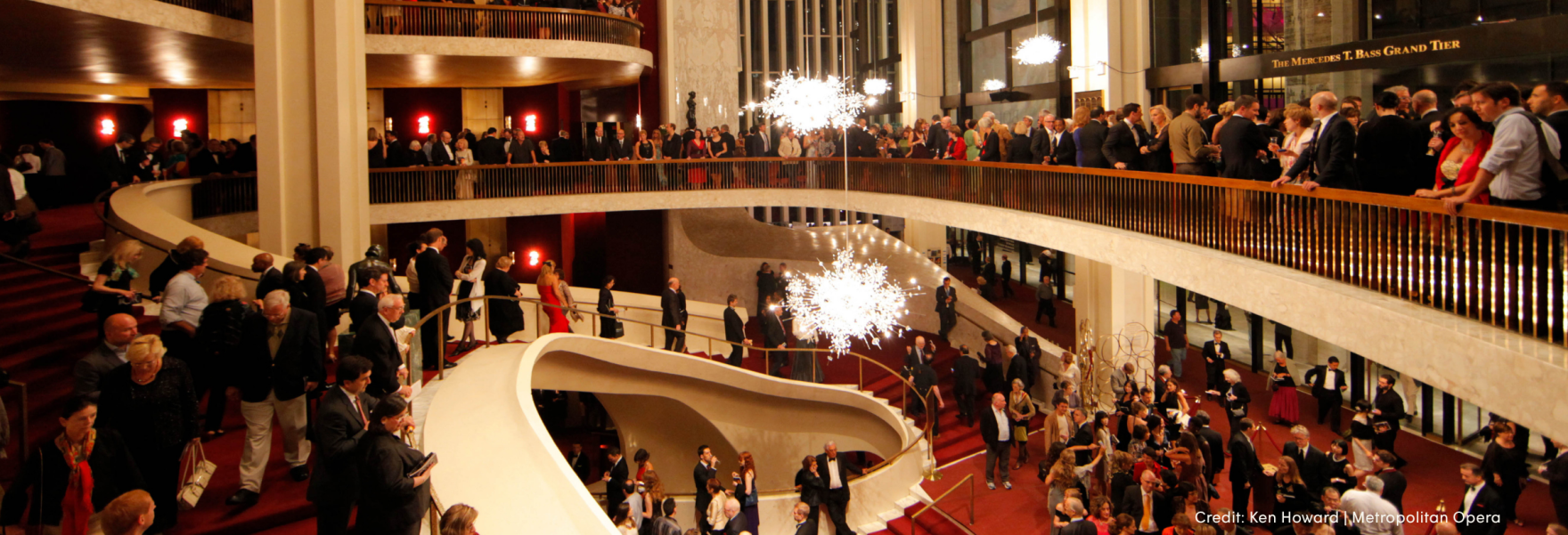
Actor Timothée Chalamet faced backlash in early 2026 for stating that he would not want to work in opera or ballet, arguing that these art forms are trying to stay alive, “even though no one cares about [them] anymore.”
Despite the controversy, Chalamet’s comment did convey some truth; opera has struggled to attract new audiences in recent years in the United States.
Yet the challenge is not uniform across markets.
To better understand these differences, Habo compared opera consumption in France and the United States, two countries with distinct live entertainment landscapes.
Arts and culture occupy a more prominent place in French entertainment consumers’ habits, whereas attention in the United States is spread across a broader range of entertainment options.
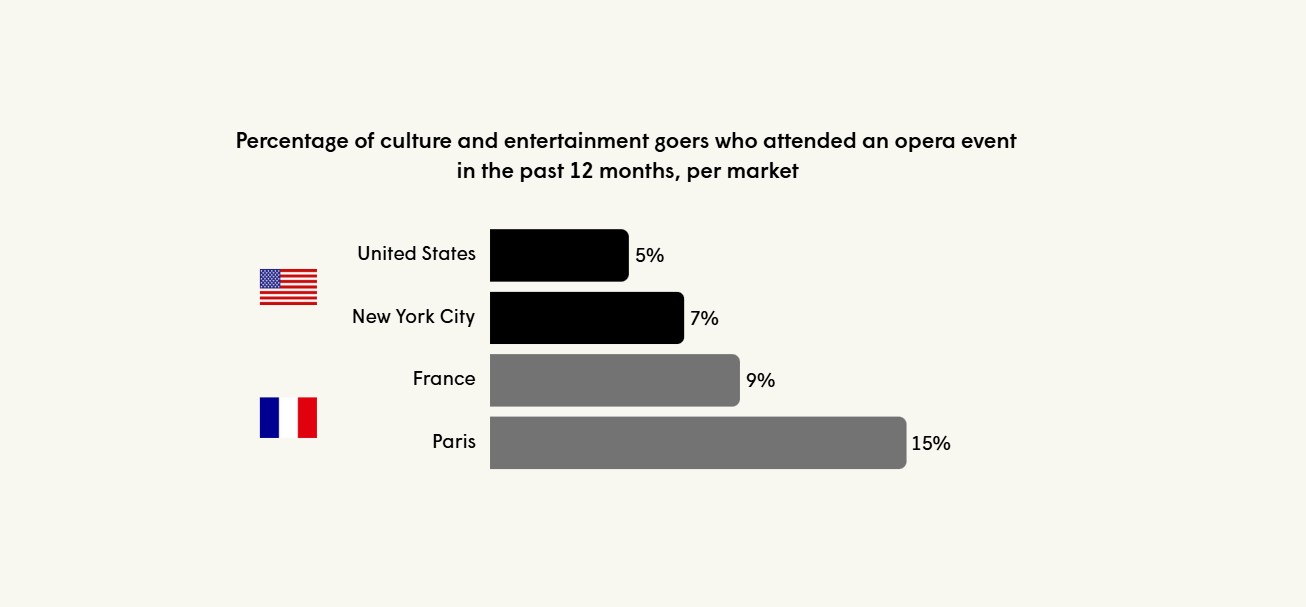
While opera appeals to targeted consumer segments in both countries, audience engagement is significantly stronger in France. Among entertainment consumers, opera attendance is roughly 50% higher in France than in the United States; while 9% of entertainment consumers in France have attended an opera performance in the last twelve months, only 5% of U.S. consumers have.
The gap is also visible in attendance rates: the Opéra national de Paris averaged an occupancy of 96% in 2025, compared with roughly 72% for the Metropolitan Opera’s 2024-2025 season.
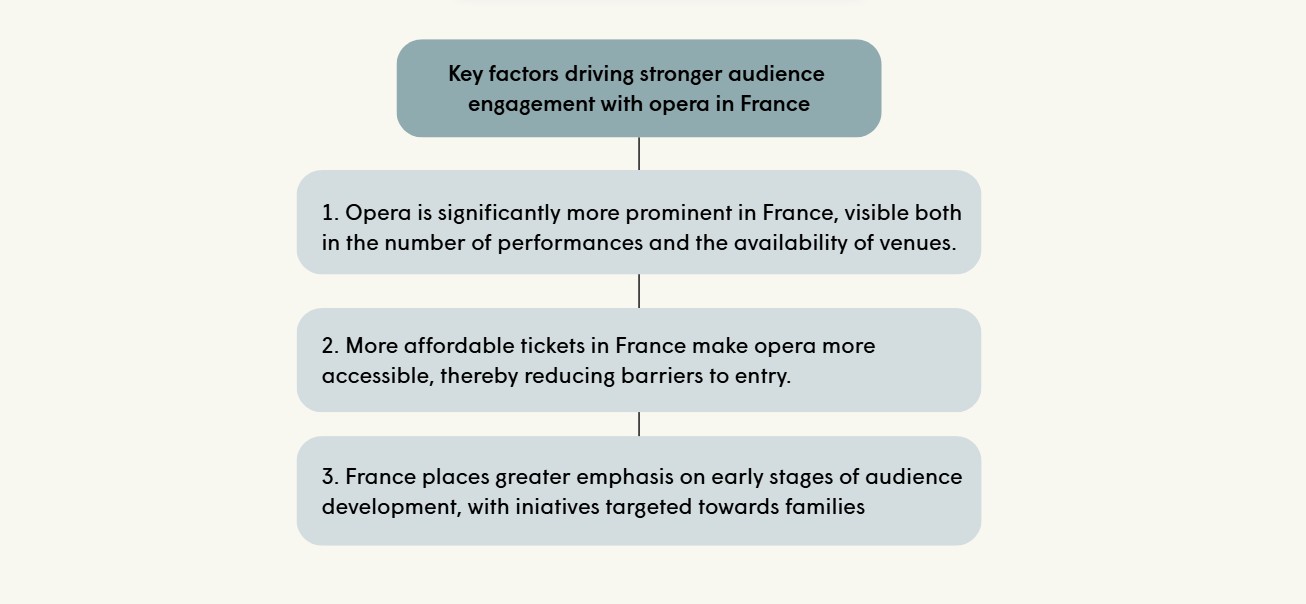
Three main factors contribute to this dynamic: opera’s place within the cultural landscape, ticket pricing, and exposure at a young age.
1. Opera is significantly more available in France, increasing its visibility and multiplying opportunities for audiences to engage with it.
Opera occupies a more prominent place in France’s cultural landscape. This difference is visible both in the number of performances and the availability of venues.
Over the past five years, France staged roughly 2.6 times more opera performances per capita than the United States, creating more opportunities for audiences to engage with the art form. France also has has 2.1 times more venues per capita that have hosted at least 50 opera performances since 1996, pointing to a denser network of venues with regular opera programming. Together, these factors make opera more present within France’s cultural landscape and easier for audiences to encounter.
2. More affordable tickets in France make opera more accessible, thereby reducing barriers to entry.
To assess accessibility in both countries, Habo reviewed non-discounted ticket prices at the Palais Garnier in Paris and the Metropolitan Opera in New York, two of the leading opera houses in France and the United States. Entry-level tickets at the Palais Garnier start at approximately €17 (about $19 USD), compared with $35 at the Met, a difference of 77%. Though the gap is smaller at the upper end of the price range, premium ticket tiers at the Met are between 26% and 56% higher than the equivalent ticket at the Palais Garnier. These pricing differences point to a lower financial barrier to attending opera in France, which may help broaden access to new audiences.
3. Opera houses in France place particular focus on families, helping cultivate the audiences of tomorrow from a young age.
Many opera houses are already investing in initiatives aimed at attracting younger audiences, including discounted tickets for students and young adults, contemporary productions, and targeted audience development programs.
Habo’s research, however, shows that long-term cultural engagement is often shaped much earlier in life, making childhood a critical stage for developing lasting cultural engagement. France appears to place greater emphasis on this stage of audience development. Institutions such as the Palais Garnier and the Opéra Bastille offer heavily discounted family programs designed to bring parents and children to performances together.
This approach reflects a broader strategic difference. Rather than focusing primarily on younger audiences, it aims to build familiarity with opera before cultural habits are established, helping create future audiences over the long term.
Both France and the United States are investing in contemporary productions, digital initiatives, and programs aimed at younger audiences. Yet Habo’s analysis suggests that opera engagement is shaped by more than modernization efforts alone.
While Chalamet’s doubtful view of opera’s future reflects certain aspects of the current reality, the barriers to broader engagement should not be attributed to a general lack of interest. Rather, they stem from the way opera is presented to current and potential audiences.
In order for opera houses and companies to expand audiences in the United States, they can adopt similar strategies implemented by France. By developing initiatives with greater availability, lower financial barriers, and stronger opportunities for early exposure, opera can become easier to encounter, easier to afford, and more likely to become part of long-term cultural habits.